Bird Feeder Poles and Squirrel Baffles
A good pole and a properly placed baffle stop more squirrels and raccoons than any feeder design on its own.
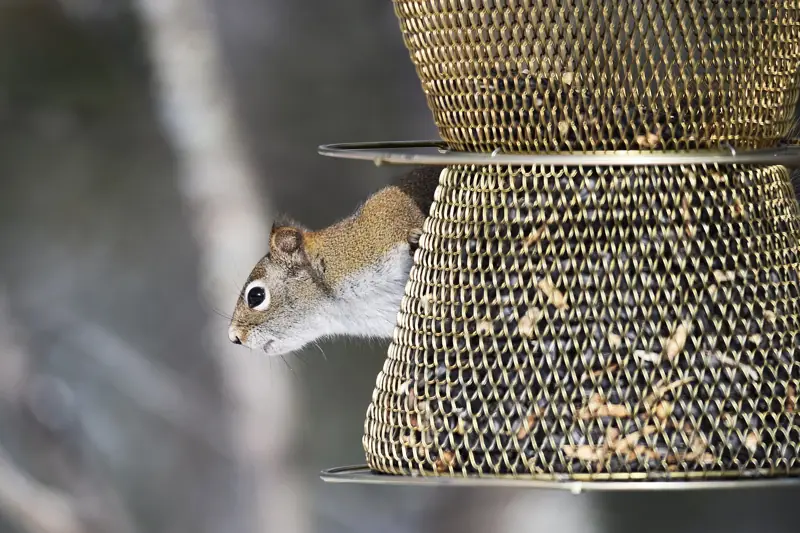
Most squirrel problems are placement problems. A feeder on a smooth pole, with a correctly sized baffle, set far enough from anything a squirrel can jump from, will stop most squirrels. It also keeps raccoons and climbing cats away from nest boxes. This guide covers the hardware and how to set it up. It is research-based, drawing on manufacturer guidance and wildlife-agency advice.
Choosing a pole
- Smooth metal, at least 1 inch in diameter. Squirrels climb wood and thin shepherd’s hooks easily. Thicker, smooth poles take a baffle and resist bending.
- A pole system with arms lets you hang several feeders, a bath and a suet cage from one baffled pole. That’s tidier and easier to protect. Keep arms short enough that a squirrel can’t jump from the ground to an arm tip.
- Stability: use a ground socket or a twist-in auger base so the pole stays upright with full feeders in wind.
- Deck and railing mounts are convenient, but railings are squirrel highways. Plan clearance carefully or use a squirrel-proof feeder.
Baffles: dome vs. stovepipe
| Type | How it works | Best for |
|---|---|---|
| Stovepipe / torpedo (cylinder) | A long tube around the pole that squirrels and raccoons can’t grip or climb past | Pole feeders and nest boxes; raccoon protection |
| Dome / cone (pole) | A wide, wobbling dome or cone below the feeder | Pole feeders where squirrels climb |
| Dome (hanging) | Wide dome above a hanging feeder that squirrels slide off | Feeders hung from branches or wires |
Size matters. A baffle a squirrel can reach around is useless. Wide (roughly 15″+) domes and long cylinders are the effective ones, which is why wildlife agencies and bluebird societies commonly recommend stovepipe-style guards for nest boxes.
Setting it up
- Pick the spot: about 8–10 feet from trees, fences, decks and roofs, with nothing overhead. It should be under 3 feet or over 30 feet from windows. The Placement Calculator checks your spot.
- Mount the baffle so its top is roughly 4–5 feet above the ground. That’s too high for a squirrel to jump onto from below.
- Hang feeders above the baffle, and check that nothing hangs low enough for a squirrel to reach from the ground.
- Move spilled seed: seed piling under the feeder draws squirrels and rodents. A seed-catching tray or hulled seed helps.
Other accessories worth having
- Weather guards (seed domes) above feeders keep rain and snow off seed and add some squirrel protection. Check weather guards
- Ant moats for hummingbird and oriole feeders: a water-filled cup above the feeder stops ants from walking down. Check ant moats
- Seed-catching trays reduce waste and ground mess. Check seed catchers
- Extension arms and hooks to space feeders apart and reduce crowding. Check hooks and arms
Don’t grease poles
Grease, petroleum jelly and oils on poles can end up on birds’ feathers, damaging insulation and waterproofing. A proper baffle works better and is safe for wildlife.
Keep exploring
Squirrel-Proof Bird Feeders: What Actually Works
Weight-activated, caged and motorized feeders compared, plus baffles, placement and seed that squirrels skip.
Bird Feeder Placement Guide: Where to Hang Your Feeders
Distance from cover, the 3-foot/30-foot window rule, height by feeder type and squirrel clearance.
Bird Feeder Placement Calculator
Window distance, cover, cats, squirrels and feeder type become a placement zone and mounting height.
Best Bird Feeders by Type
Research-based picks for tube, hopper, platform, finch, suet, window and squirrel-proof feeders.
Bird Feeder Types: Which Feeder for Which Birds
Tube, hopper, platform, suet, nyjer, hummingbird, window, squirrel-proof and smart feeders compared.
Birdhouse & Nest Box Guide: Dimensions, Placement and Species
Entrance hole sizes, box dimensions, mounting heights and predator guards for common cavity-nesting birds.