Squirrel-Proof Bird Feeders: What Actually Works
No feeder beats a squirrel on its own. The right feeder design, a baffled pole and the right placement together do.
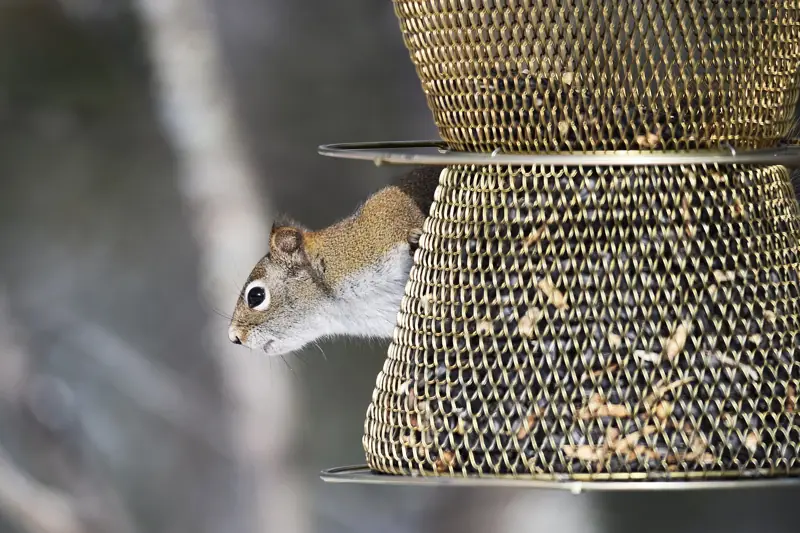
Squirrels are impressive animals. Gray squirrels are strong jumpers, agile climbers and persistent problem-solvers. Squirrel-proofing is achievable, but expectations matter. There is no single magic solution. What works is a layered strategy combining the right feeder design, correct placement, and in some cases, the right seed.
This guide is research-based. It draws on manufacturer designs, wildlife-agency guidance and recurring patterns in owner reviews. We haven’t run our own squirrel trials.
Why Squirrels Are So Hard to Stop
Eastern gray squirrels (Sciurus carolinensis) are among the most athletically capable backyard animals in North America. The basic numbers matter here:
- Horizontal leap: commonly cited as 8–10 feet
- Vertical leap from the ground: roughly 4–5 feet
- Can hang upside down by the hind feet and stretch down toward a feeder
- Climbing ability: essentially any surface with a rough texture
- Weight: 14–21 oz for Eastern gray squirrels
Any squirrel-proofing strategy has to account for all of these. A feeder that’s squirrel-resistant by design but placed 8 feet from a tree will be raided within minutes.
The Four Methods That Actually Work
1. Weight-activated feeders
A spring-loaded perch or outer shroud slides down and closes the ports when something heavy grabs on. Most songbirds weigh well under 2 ounces. Gray squirrels weigh over a pound. Heavier birds such as blue jays, mourning doves and grackles can also trip the mechanism, which some people consider a feature. The Brome Squirrel Buster line is the best-known example. Owners generally rate it highly, and several models let you adjust the closing weight.
Look for: metal construction or chew-proof parts, a mechanism you can adjust, and a design that comes apart for cleaning.
Motorized spinning-perch feeders
A battery-powered perch ring spins when a squirrel’s weight lands on it, and the squirrel slides off. The Droll Yankees Flipper is the classic example. They work, but they need batteries and more maintenance than purely mechanical designs.
2. Caged feeders
A cage feeder has a wire mesh cage surrounding a central tube or tray feeder. The mesh openings are large enough for small and medium birds to pass through but too small for squirrels. This is one of the most reliable physical solutions because it doesn’t rely on any mechanical threshold — it’s a permanent physical barrier.
The limitation: large birds like Northern Cardinals, Blue Jays, and larger woodpeckers also can’t get through the cage. Caged feeders work best when you want to create a dedicated feeder for smaller species like chickadees, nuthatches, titmice, and house finches, while using other feeder types for larger birds.
Look for: enough gap between cage and tube that a squirrel can’t reach through to the ports, powder-coated steel, and a top that opens easily for filling and cleaning.
3. Baffles
A baffle is a physical barrier that prevents squirrels from climbing up a pole or descending from above. Baffles are one of the most cost-effective solutions because they can make any feeder squirrel-resistant, not just specially designed models.
Pole baffles mount on a pole below the feeder and create an overhang that squirrels can’t climb around. Both dome and long cylinder (“stovepipe” or “torpedo”) baffles work when they’re wide and long enough and mounted at the right height. Cylinder baffles also stop raccoons well.
Hanging baffles mount above a hanging feeder on the line or hook. A large dome baffle (at least 15 inches wide) above a hanging feeder prevents squirrels from descending from above. The baffle must be mounted high enough that a squirrel hanging from it can’t reach down to the feeder.
Critical placement rules for baffles to work:
- The top of a pole baffle should sit about 4–5 feet off the ground, with the feeder above it
- The feeder should be roughly 8–10 feet from any tree, fence, deck, roof or structure a squirrel can jump from
- Nothing overhead that a squirrel can drop from
See feeder poles and baffles for sizing and setup.
4. Placement
Even without a baffle, correct placement alone can dramatically reduce squirrel access. Put the pole in the open, about 8–10 feet from anything a squirrel can launch from, with the feeder about 5 feet up and nothing overhead. The Placement Calculator checks your spot.
In practice, most backyards can’t achieve all three conditions simultaneously, which is why physical deterrents are usually also necessary. But placement is the foundation — even the best baffle fails if the feeder is too close to a fence.
Squirrel-Resistant Seed Types
While no seed is completely squirrel-proof, some are much less attractive to squirrels than others:
- Safflower seed: many squirrels eat less of it than sunflower, though some eat it anyway. Cardinals, chickadees, titmice and doves take it readily. Check safflower on Amazon
- Nyjer (thistle) seed — too small and fine for squirrels to eat efficiently; goldfinches and siskins love it. Use in a dedicated nyjer feeder with small ports.
- Hot pepper (capsaicin) seed or suet: birds are insensitive to capsaicin, the compound that makes peppers hot, while mammals feel the burn. It works for many people and costs more. Wash your hands after handling it. Check hot pepper seed
Foods that attract squirrels most: sunflower, peanuts and corn. These are squirrel favorites and will draw them to feeders aggressively.
What About Squirrel-Proof Poles?
Smooth metal poles are much harder for squirrels to climb than wooden posts or rough-surfaced poles. If you’re starting from scratch, a smooth galvanized or powder-coated metal pole (1”–1.5” diameter) combined with a dome baffle is one of the most effective setups you can build. Squirrels can still climb some smooth poles, so add a baffle.
Avoid shepherd’s hook poles if squirrel control is a priority — the curved shape and textured finish make them easy for squirrels to shimmy up.
The Squirrel Feeder Solution
A counterintuitive but genuinely effective strategy: give squirrels their own dedicated food source well away from your bird feeders. Ear corn, whole peanuts in the shell, or a squirrel-specific feeder filled with sunflower seed, placed at the far end of the yard, can redirect most squirrel activity away from your bird setup.
This works especially well combined with a physical deterrent setup at the bird feeders. You’re not solving the squirrel problem, but you’re giving them a compelling alternative that keeps them busy.
Figuring out how squirrels get in
If the setup still fails, watch for a morning to see the route. It’s usually a jump from a fence, railing or branch that looked far enough away. A camera feeder or an inexpensive trail camera can show you what happens while you’re out, including raccoons at night.
Squirrel-Proofing Quick Reference
- Best physical deterrent: Weight-sensitive feeder + dome baffle on a smooth pole
- Best seed approach: Safflower, nyjer, or hot pepper-treated seed
- Pole clearance: about 8–10 ft from launch points; feeder about 5 ft up, above the baffle
- Best cage feeder use: Dedicated small-bird feeder (chickadees, nuthatches, finches)
- Squirrel feeder redirect: Works well as a supplemental strategy
- Don’t: grease poles. Grease and petroleum products can foul birds’ feathers. Sprays on surfaces wash off quickly.
For more on which seeds to use in your squirrel-resistant setup, see our complete bird seed guide. And if you want help planning the right feeder layout for your specific yard, try our Feeder Setup Planner for a personalized recommendation.
Keep exploring
Bird Feeder Poles and Squirrel Baffles
Pole systems, dome vs. stovepipe baffles, mounting heights and the accessories worth adding.
Best Bird Feeders by Type
Research-based picks for tube, hopper, platform, finch, suet, window and squirrel-proof feeders.
Bird Feeder Placement Guide: Where to Hang Your Feeders
Distance from cover, the 3-foot/30-foot window rule, height by feeder type and squirrel clearance.
Bird Seed Selector
Choose a bird, season and your squirrel and mess tolerance. Get the seed and feeder to use.
What Bird Seed Attracts Which Birds? Complete Backyard Guide
Which birds eat sunflower, nyjer, safflower, suet, peanuts and millet, with the right feeder for each.
Bird Feeder Placement Calculator
Window distance, cover, cats, squirrels and feeder type become a placement zone and mounting height.